My School
Our school, the Secondary technical School of transport, has a rich history dating back to its foundation in 1983. Over the decades, it has evolved significantly through several major renovations and the construction of new pavilions to meet the needs of modern technical education. Today, the campus is organized into a logical layout consisting of four main pavilions: A, B, C, and the Peugeot pavilion.
The Peugeot pavilion is one of the most unique parts of our school. It is a large, specialized hall where we can see real cars and various technical equipment. It also features detailed mini models of railways and authentic components from the real-world railway industry, which helps us connect our classroom theory with physical engineering. Another important social and educational hub is Pavilion C, which houses a large presentation room known as Svetlík.
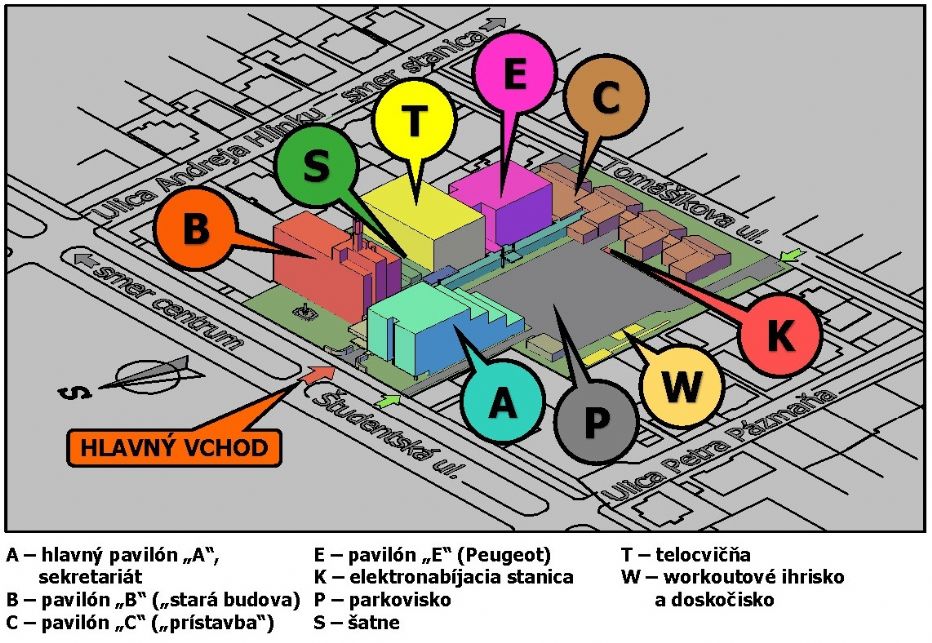
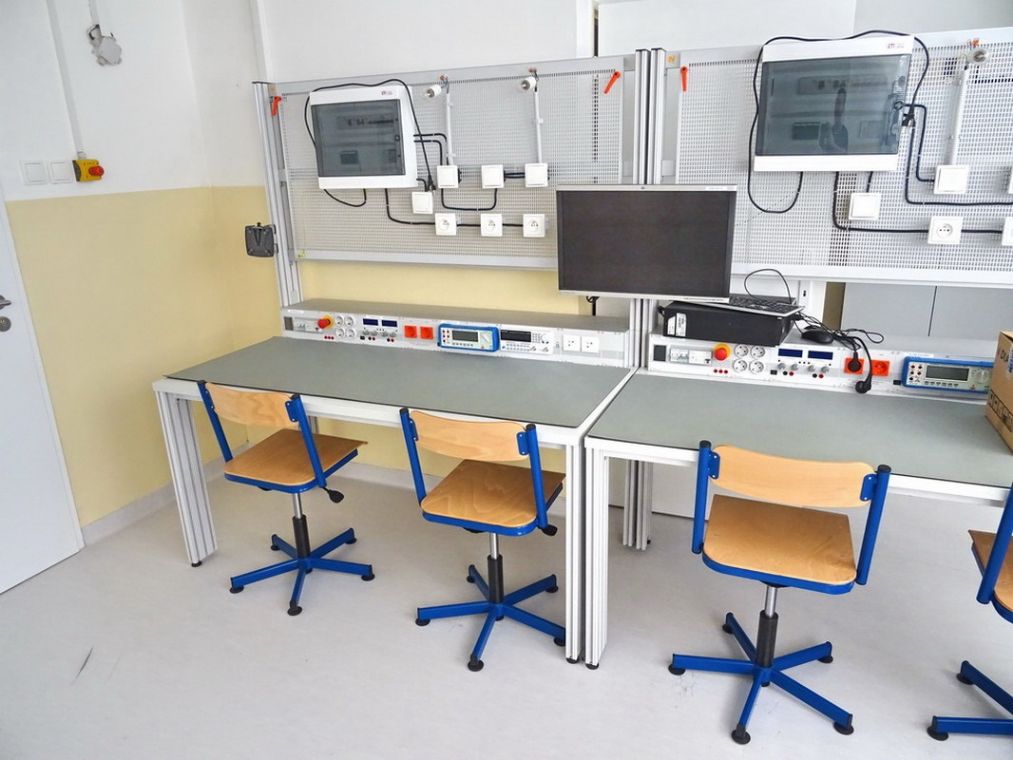
This space is designed for bigger gatherings, guest lectures, and student presentations. The school is well-equipped for both professional training and student life. We have several technical laboratories and modern computer rooms where we practice subjects like Applied Informatics or electrical practical exercises. For physical health, we have a traditional indoor gym, locker rooms, and an outside gym for fresh-air exercise and for our mental health we have a psychologist we can come to if we need.
Our school offers a diverse range of specialized study programs designed to prepare students for the rapidly evolving world of technology, transport, and logistics. Each program is carefully crafted to combine theoretical classroom knowledge with practical hands-on experience in our laboratories and pavilions. Below is a detailed overview of the five main study divisions available at our institution.
1.Electrical Engineering – Communication and Computer Systems
This program is ideal for students who want to become experts in the digital backbone of modern society. It focuses
heavily on computer networks and information technology, as well as broader electrical and communication systems.
A major highlight of this study path is the opportunity to obtain the globally recognized CISCO certificate, which validates
your skills as a networking specialist. Furthermore, students gain the legal electrical qualification required by Decree
No. 508/2009, allowing them to work safely with electrical equipment.
Career Opportunities: Graduates find success as network technicians, IT and PC support specialists, or telecommunications experts.
2. Electrical Engineering in Transport and Telecommunications
This division specializes in the safety and computer systems specifically used within the transport sector.
Students learn about complex signaling and telecommunication systems that keep railways and roads safe. Interestingly,
this program also includes a creative side, focusing on multimedia such as video and audio processing. Like the previous
branch, students can earn the CISCO certificate and the electrical qualification under Decree No. 508/2009.
Career Opportunities: This path leads to roles such as safety systems technician, signal master, telecommunications specialist, or even a train driver.
3. Transport Operation and Economics – Logistics and Business
For those interested in the "moving parts" of the global economy, this program focuses on logistics and entrepreneurship.
Students learn how to organize and secure the transport of goods across the world. The training is very practical,
utilizing professional software used in real companies today. You will gain deep knowledge of how shipping and transport
chains are organized to be efficient and profitable.
Career Opportunities: Graduates work in logistics companies, forwarding firms, road and rail transport departments, or even in customs and private transport businesses.
4. Transport Technology and Operation – Automotive Technology
As the automotive industry changes, this program stays ahead by focusing on the construction, maintenance,
and diagnostics of motor vehicles. It places a strong emphasis on the future of transport, specifically electromobility
(electric cars). Students also learn modern design skills using CAD systems and 3D graphics, which are essential for any
modern automotive technician.
Career Opportunities: Graduates can become car sales representatives, automotive technicians, dispatchers, or start their own businesses in car repair and maintenance.
5. Transport Academy – Economics, Management, and Forwarding
This program is designed for students with an interest in the business and administrative side of transport.
It focuses on training future economists and accountants specifically for the transport sector. The curriculum
includes practical training on professional software and the study of two foreign languages, which is a huge advantage
in international business. You will learn everything about warehouse management, financial accounting, and marketing.
Career Opportunities: Potential roles include manager, transport accountant, payroll officer, billing clerk, or marketing specialist in a transport company.
The infrastructure also includes a large parking lot for staff and students. For our daily needs, the school canteen is located on the -1 floor and there is a popular buffet near the entrance for snacks and drinks.
One of the modern features of our school is the security system at the gatehouse. We use NFC chip cards at the entrance gate; we have to "beep" our cards so the system can record that we are safely in school. The hallways are also designed for relaxation and interest. There are three vending machines for quick refreshments and three special glass rooms. One contains a fascinating mini model of a railway with moving trains. The second glass room has an open roof, providing a "chillout" zone where we can enjoy the fresh air during the summer months. The third glass room serves as an exhibition space for two cars.
Inside the classrooms, the environment is typical of a Slovak secondary school, featuring a clean yellow and white colour scheme. The rooms are bright thanks to large windows located opposite the doors. The furniture consists of organized rows of school desks and chairs. For teaching, we use versatile boards that have a traditional chalkboard surface on the inside and a modern whiteboard on the outside for markers.
A typical day at our school is structured around discipline and a steady learning pace. The tuition starts exactly at 8:00 AM but for example, health education instead of physical education and it starts an hour earlier. On average, we attend between five to eight lessons a day, depending on our schedule.
There is a formal culture of respect between students and teachers. When a teacher enters the classroom, the entire class stands up to greet them in silence. The teacher then opens the class register to mark any absent students. Most lessons begin with a revision of the previous topic. This is a crucial part of our day, as the teacher often examines a student individually. The student is asked to come to the board to solve exercises, explain a complex technical problem, or respond to the teacher’s questions. This method ensures that we stay prepared and truly understand the technical subjects we are studying.

Obrázky použité na tejto stránke sú čerpané zo stránok:
Vlaky.net